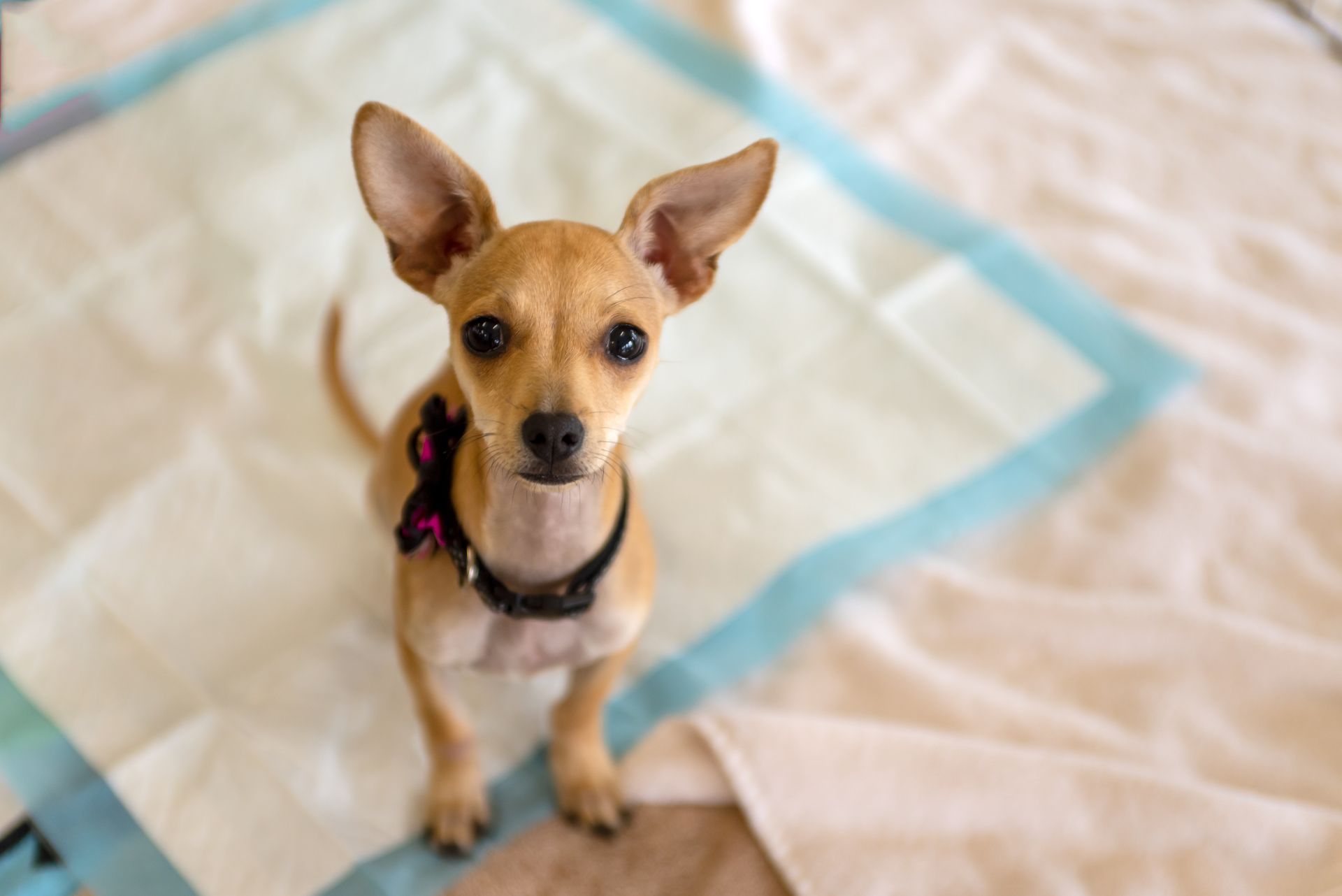
It is normal for puppies not to want to soil their nesting area and the goal is to have them understand that the entire house is their nesting area. This is best accomplished by initially limiting their space to a dog crate when not being actively supervised. The crate should have just enough room to stand up and turn around in. If you purchased a crate larger than that, then a cardboard box can be added to shrink down to a desired space. Once housetraining is coming along then the space can be expanded. Start with the kitchen and the family room. If that is going well then gradually add on other rooms of the house. Puppies generally need to eliminate after eating, when released from confinement, after any play and after waking up, even from a short nap. So be sure to take your puppy outside right after, preferably to an area of grass or at least loose leaf/plant litter. You can use cue word(s), e.g. “do your business”, “hurry up”, or “potty”, when your puppy eliminates outdoors. Besides telling them they’re good, give a favorite food treat with more praise. You’ll always get further with positive reinforcement than any negative discipline. Signs your puppy may need to eliminate include circling, sneaking off and heading to the door. Immediately, take your puppy to its elimination site, give your verbal cue and as soon as elimination is complete, lavishly praise and give a food treat. If you catch your puppy starting to eliminate in the house then picking them up and saying “no” in a low voice while carrying them outside to eliminate is fine but otherwise negative reinforcement is not helpful and may result in you puppy being fearful of your approach. Also, punishment increases the likelihood that your dog will not eliminate in front of you but unlikely to stop them from eliminating in the house when you’re not looking. Bottom line is you want to reward your puppy for doing the correct thing. They will then want to wait to eliminate outdoors in anticipation of the food treat. Walks outside before any confinement or bedtime will encourage elimination and make it easier to wait until the next opportunity. If your puppy has an accident in the house, you should put them somewhere else where they cannot see you clean up their mess. Otherwise, they view this as getting attention and therefore, rewarded for eliminating in the wrong location. It is important to remove any remaining odor as that will encourage them to continue to eliminate in that location. A product that combines an enzyme and detergent is best. If possible, it is best to prevent access to that location by placing furniture such as an ottoman over that spot. Generally, if the puppy did not have any accidents in the house for several weeks, you can gradually expand your puppy’s access to the rest of the house without supervision. If your puppy is having problems making it through the night, then taking the water bowl away 2 hours prior to bedtime and again, long walks outdoors prior to bedtime can help. Usually by 4 months of age, puppies can make it through the night. Be aware that being housetrained to your house doesn’t necessarily mean your puppy is housetrained to another house. It is best to go straight to train to eliminate outdoors rather than paper training or training to use house training pads. Otherwise, your puppy may not quickly understand that elimination is to be done outdoors and not indoors. An exception would be those living in a high rise or when it is not practical to take the puppy out frequently enough. The puppy can be confined to a small area covered in paper except for the sleeping area and once the puppy chooses a location then gradually shrink down the paper coverage to just that location. Finally, you will always get further and faster when training with positive reinforcement than negative discipline. Your puppy will quickly learn to wait until going outside to do their “business” since there is going to be favorable attention and a food reward.
Kenton Taylor, DVM
Kenton Taylor, DVM
Kenton Taylor, D.V.M.
Kenton Taylor, D.V.M.

Kenton Taylor, D.V.M.
Kenton Taylor, DVM

Kenton Taylor, D.V.M.

Kenton Taylor, D.V.M.

Kenton Taylor, D.V.M.